Tuesday, August 27, 2013

Fishing the Sh-Sh-Shoshoni National Forest, Wyoming


9-18 August 2013

In a moment that she may have regretted later, my wife suggested that I take a week-long “baby-moon” fishing trip before our first child comes in December. Thus began the planning between my best friends from high school, father and his friend that lead to a fishing trip that spanned the Shoshoni National Forest in northwest Wyoming. 
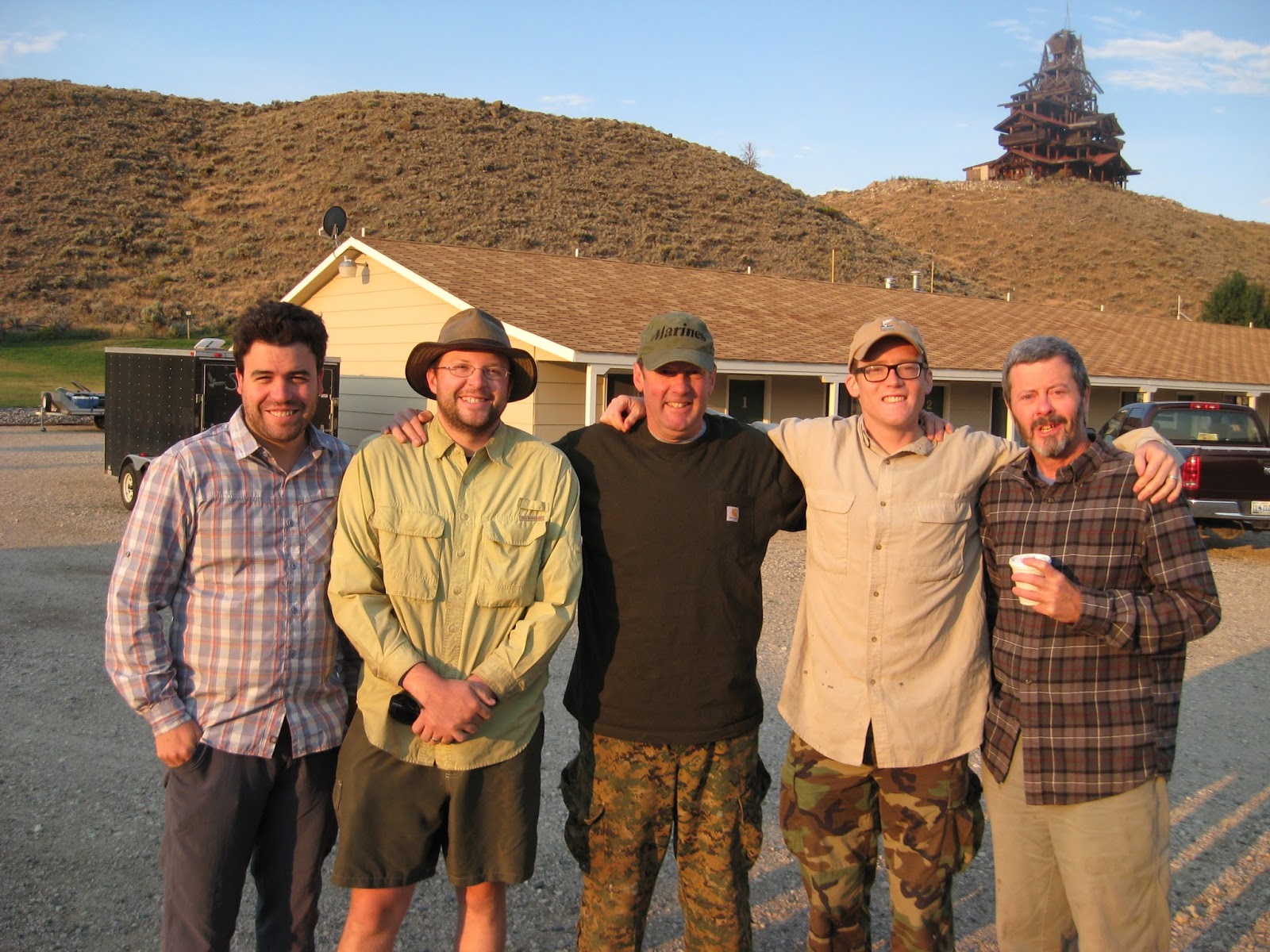

The fishing trip was centered around a four-day pack trip into the Washakie Wilderness in the Shoshoni National Forest. We arrived in Cody on a Saturday, four days before the pack trip, and fished the Shoshoni and other surrounding creeks.

Cody, WY

 We chose Cody as our base to fish because it was near the outfitter who was packing us in. In retrospect, we could have stayed closer to where the outfitter was packing us in. However, Cody was a great base to fish from. It has a Wal-Mart and a Sierra Trading Post, plenty of restaurants and a nice downtown. Cody also has a rodeo every night from June through August at 8 pm. 

 
We stayed at the Green River Inn which was about 20 miles west of Cody. The best landmarks are the Last Chance Gas Station (last chance for gas before Yellowstone National Park) and this strange looking house. The house, which I initially took for some strange mining structure, was the 18-year project of some engineer who lived in Cody. He apparently died in a fall from his little structure.


For restaurants we tried the Trail Shop Motel twice and the Yellowstone CafĂ©. The Trail Shop Motel was an unexpected gourmet oasis. Both times I got the spinach fettuccini with vegetables. It was very filling and had a great spicy kick. Both places had small, but reasonable draft menus. The Trail Shop had the Sweetgrass APA and New Belgium’s 1554. The Yellowstone Cafe had a nice bison burger.

While there are two fly shops in Cody, the North Fork Anglers were the only ones that were open while we were there. The lady was very friendly and offered great advice. While it is not where I would go to gear-up for a trip, it is definitely the place to stop and get your flies. For this trip I relied heavily on:

·         Hoppers
·         Grey humpies
·         N. Fork Specials (any golden stonefly)
·         Prince nymphs
·         Copper johns

The fly on top is a prince nymph which was decimated by about 30 fish. The one one bottom is what is used to look like.

Boulder to Cody

 It takes about 8.5 hours to get from Boulder to Cody. You pass by the large Sierra Trading Post in Cheyenne which is worth a stop for some last-minute outfitting of any camping and fishing gear. For lunch we stopped at the Wonder Bar in Casper. This is a fun brewpub with a good spread of food. Justin and I tried the fish tacos. They only had four house beers when we were there, I tried their IPA and Red. The red had a nice hoppiness to it and a bit of lingering yeast flavor. It was also only $4.50 for 24 ozes.

Once your leave Casper there are not too many other towns. We left Cody on Route 26 and drove through high desert country. We finally got a break from the high-country desert when we turned north on Route 20 and went through a beautiful canyon of the Wind River above the Boysen Reservoir.  Once you reach Thermopois (which is lacking in Spartans) you still have an hour-and-a-half.

Floating the Shoshoni


Length:10 miles
Time: 6-7 hours (fishing hard)
Water: 275 cfs
Launches / Take-outs:
·         Old Town Trail: 44° 31.107'N 109° 6.793'W
·         Town landing: 44° 32.031'N 109° 3.760'W
·         Corbett Bridge: 44° 34.615'N 108° 58.351'W


Justin and I went in on a 13-foot Super Puma a few years ago and it has been a great boat. We launched at the Trail Town Road (on Google Maps it’s called Demaris Dr, but it is behind an Old Trail Town billboard). This landing has a gate to prevent guide services from using it so you have to carry your boat down. The first 10-15 minutes of floating also reek of sulfur and have lousy fishing. However, as compensation for the smell you have beautiful red-rock canyons and once you get about 10-15 minutes downstream, the fishing is great.


The take-out at Corbett Bridge is on the left and not too hard to get to. The river itself has some class II and light class III, but it not too bad in a raft. We would have floated the North Fork of the Shoshoni as well, but the water was too low in August.

The best strategy that we found was to go through the runs and then eddy out. The fish seemed to be near the banks. While we were there they loved copper johns in the upper stretch. We caught mostly Yellowstone Cutts and 'bow in the upper portion.
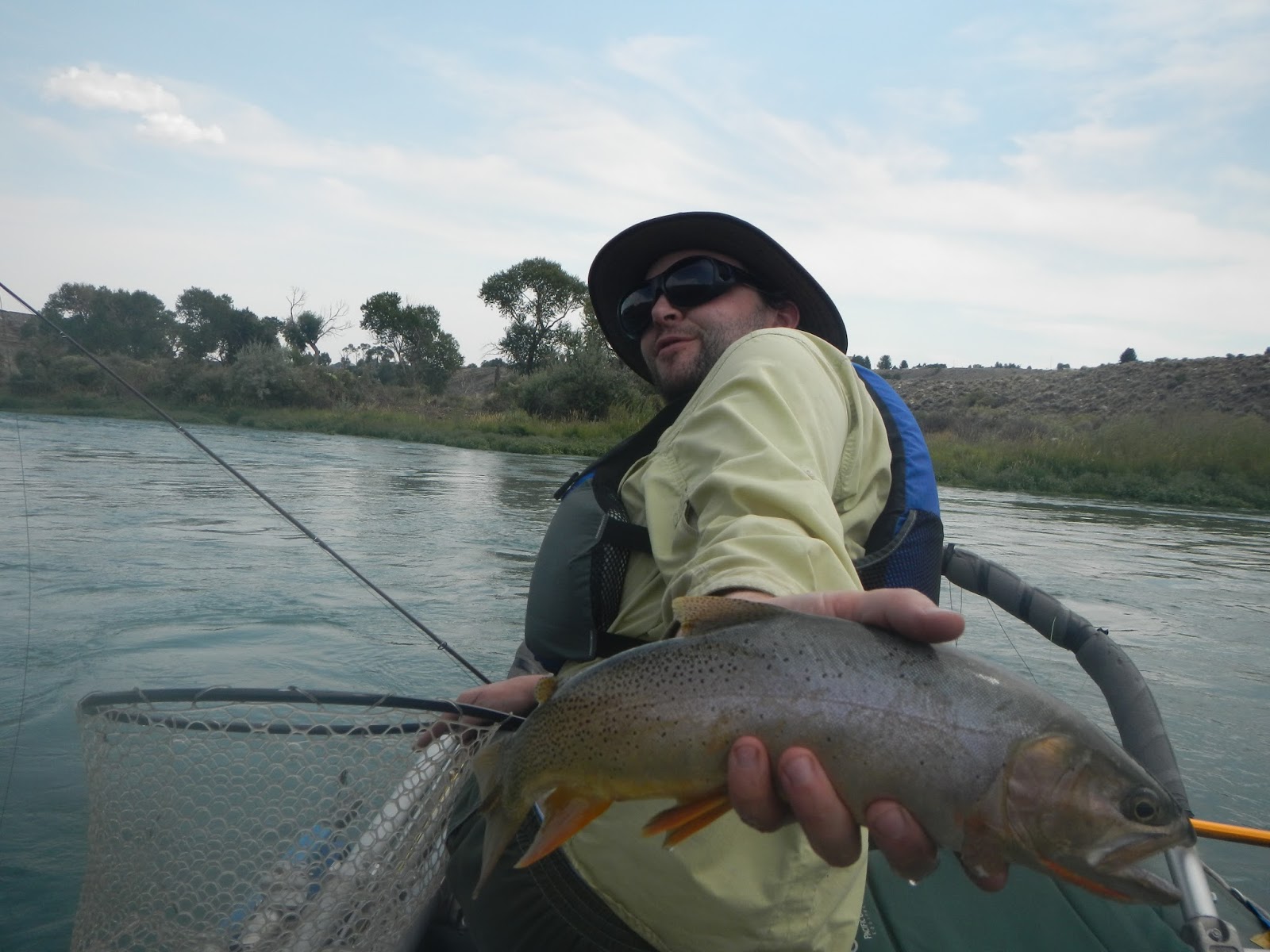
About lunchtime we would stop at the town landing which was at the edge of 12th street. Once day we even walked up into town for lunch.

Once we got below the town landing the fishing was always slower. Here we found streamers to be the best bet. A sink-tip line definitely improved our odds. Of course, it also could have been the time of day, since we allways fished this stretch in the afternoon. We also seemed to catch more brown in this section. The average size for this whole stretch was around 12-14”.

Wade fishing around Cody


Eagle Creek Trailhead: 44° 28.146'N 109° 53.232'W
Fishhawk Creek Trailhead: 44° 26.973'N 109° 50.031'W
Clearwater Creek Trailhead: 44° 27.825'N 109° 40.258'W

My father and his friend fished Eagle & Fishhawk Creeks the first two days while my friends and I were floating the Shoshoni. They found both to have good flows and good trails beside them. They caught mostly brookies in these two creeks and mostly on hoppers (although that was the primary dry fly they fished). My father also had good luck with Spinners.

All of us tried Clearwater Creek. This one was thinner than Eagle or Fishhawk and was more pocket water fishing. There was also a good trail that followed the stream. We trail crosses the stream about a mile in and then re-crosses the stream pretty quickly. We hiked about 2.5 miles in before we started fishing (to try and get away from the pressure) The fishing was not spectacular, but it was fairly steady. Most good drifts with a dry-dropper (Size 14 stimulator – size 14-16 pheasant tail) usually produced rainbows in the six to eight-inch range. My final fish of the day was a surprising 14” brookie caught right above the first stream crossing.


My father and his friend tried Sheep Creek in the afternoon but found it rather overgrown and with little to show for fish.

Pack Trip Camping


Trailhead: 44° 6.501'N 109° 21.097'W
Time: Cody to Trailhead ~2 hours
Trail to campsite: 11.6 miles, 4 hours on the horse (~3 mph)

While not something that I would do all the time, doing a pack trip is a really fun way to fish. Our guide, Karl, packed the mules, set up camp, cooked and cleaned. All we had to do was keep on the horse and fish (generally not at the same time).

Our guide, Karl, leading the pack mules

Traveling by horse to your camp or fishing hole really makes you feel like you are in the west. It is also a literal pain in the butt. And knees. Karl said that if you knees hurt your sturrups are too high. If your butt hurts the sturrups are too low. If both hurt you have them set right. The other key was to keep the horse up with the pack mules. If you let it eat grass or fall behind you had to endure the trotting.

Fishing the Greybull


The Greybull has a wide range of looks. One day we fished a canyon section with some great deep runs. Some of the best runs had almost twenty 10 to 12-inch fish. Another day we fished the braided section near where Venus Creek comes in. The fish were not quite and big and there were not quite as many per hole. Finally, we tried another canyon section farther upstream. We fished this section early in the morning and had much sparser luck. After we got back our guide noted that the fishing is slow until the sunlight hits the canyon.

Canyon stretch above our campsite. You hike about another half miles south and fish where it opens up a little.
The fish did not seem to be particularly picky. My friend fished primarily with a hopper-dropper. The fishing was good and consistent with the hopper, but the majority of the hits were below the surface. I fished 90% of the time with a size 12 stonefly with a size 14 or 15 bead-headed prince nymph. The indicator was about 3 ft above the stonefly. The prince nymph was 2 ft below the stonefly.
 
Jeremy fishes a nice set up rips in the braided section near Venus Creek

With much regret we eventually packed out of the Greybull. We checked into our hotel, showered and packed our gear. In the morning we went back home to our wives. No doubt about it, we're pretty blessed.


Wednesday, August 7, 2013

Wild West Relay - Part 2 - Lessons


While I have done relay races like the Wild West Relay many times, this is my first time “captain-ing” a team. While we got every runner where they needed to be and ran a great race, I still learned a lot of things to do better next time. Some of these things are more applicable to the Wild West Relay, but many of them I think could be used in any large team relay race.

Improves

Water: For our vehicle we found that 7 gal water / vehicle was just barely sufficient. 10 gal would have been better. There are a decent number of exchanges where you can fill individual water bottles and we did not do a very good job using these opportunities

Delegate creative stuff:  shirts, vehicle decoration, etc. It would have been fun to have shirts and decorate the vehicles. I did not have the time or creativity to do this.


Light-up slap bracelet: One of our runners brought a red-blinking slap bracelet. It satisfied the race requirement to have a red blinking light. But what really made it great was that it made it easy to find our in the dark.

Van Exchange 18: This one is unique to the Wild West Relay. You need to have a good link-up plan for this exchange. One idea would be walkie-talkies. Most of the time walkie-talkies would not have been that useful. Cell coverage was generally decent. However, there at Exchange 18 there was no cell coverage, it was dark and the inactive vans were parked way in the back (near where you could sleep) will the incoming active vans were parked up front. An easier idea than walkie-talkies would be to choose a link-up place (based on Google Earth) before-hand.

Sustains
Our team did stumble on some good ideas as well

Calculating splits: One of our runners who had more experience in these types of relays deducted the factors that the WWR used to calculate our total times. We plugged this into a spreadsheet to calculate our runner’s splits. The split calculations were invaluable to predicting when the inactive van had to wake up. We found it was best to set the alarm 45-60 min prior. The predictions, while not always accurate for individual legs, were very accurate overall. We finished with 7 minutes of our predicted time. We would were occasionally off by as many as 20 minutes, but it always came back to close to even.

These factors were:

Leg Difficulty Rating
10k Split Factor
Easy
1.03
Medium
1.08
Hard
1.13
Very Hard
1.25


Hand roller: the hand roller that one of our runners brought was great for working out the leg muscles while waiting around. For the situations of this relay a foam roller is not quite as useful as a hand roller which can be used in the van or while standing.

Chevy Suburban: We were a van short, so we rented a Chevy Suburban. This is an excellent relay vehicle. It had ample room for six people and gear. Aside from a 15-passenger van this is the most popular vehicle that I saw on the course.

General observations
Short Legs: For legs less than 4-5 miles it is best just to drive to the end to give the next runner time to warm-up and use the bathroom.

Food:
·         Avocado & cream cheese sandwiches are amazing
·         Sweets were not particularly popular. We brought cookies and brownies. Neither went very fast.

Wildlife and Dirt: Van No. 1 gets all of the dirt roads and animal sightings. I was jealous. Next year.

Photo: Ynke

Tuesday, August 6, 2013

Wild West Relay - Part 1


This is my second relay race of the year, but my first non-Cabot Trail Relay. My intent was to do a fun running event with my co-workers. In the end, we managed seven co-workers in a team of twelve. For the rest of the team we recruited one significant other and four other running friends. While the Wild West Relay site recommends have one or two alternate runners, I have found from the start of planning to race day, it is best to have about 50% more runners than final spots. Life and work will inevitably take their toll on your final numbers.


We met up in Boulder early on Friday morning. After packing vans and taking a few before photos, we headed up to the Budweiser Plant in Ft. Collins. The start of the relay is staggered so that slower teams start earlier. We were fortunate to have assembled a reasonably fast group of runner and therefore got a leisurely start time of 10 am.

Start of the Relay

Laura kicked off the relay for our team. We started with one other team – The #1 Stunners. We watched Laura head off into the distance and then divided into our vans. In order to reduce congestion on the course and at the hand-offs, the 12-person teams are required to travel in two 6-person vans. The first van picks up and drops off runners for the first six legs. The second van carries runners seven through twelve. This van is required to drive to the end of leg 6 / start of leg 7 – often along a different route. Since I did not get to travel with Van 1, this account is mostly of my teammates in Van 2.


Since I was with the second van so we had a little spare time before we had to run. We decided to use this time wisely by touring the Budweiser plant. The stats of their production wash over you like a flood. While I do not chose a “Bud” when I am at the bar, the engineer in me was impressed with the mechanics of producing beer on such a massive scale. We carbo-loaded with a few free ounces at the end and drove to the start of Leg 7.

When Inke finished leg 6 for our team we learned that they had fully experience the “Wild West” part of relay. Inke had fought her way through a herd of cows that crossed the road to get to us.

Photo: Ynke

Legs 7

Ben Knurr kicked off his first leg – and quick 3.7 miles and then handed off to me for my first leg (Leg 8) around 2:30. It instantly became clear that this was going to be a bit of a slog for me. For starters the bagel that I had eaten was sitting like a brick in my stomach. Then headwind and low humidity combined to leave my mouth parched in the first half-mile. Then there was the 1,100 feet of climb over the next 6.4 miles. While none of these hardships compare to some of Colorado’s more notorious races (Hardrock 100, Pike’s Peak, etc.) they were sufficient for me. I was glad that it was only 6.4 miles and was grateful to hand off to Robin at the top of the hill. Robin, Dave, Jordan and Lisa as had fine lead-off legs. We reached our Van 1 teammates around 5:15.


Camping at Exchange 18

The drive to the start of Leg 18 was beautiful. As the inactive van we took a detour through the Routt National Forest. When we rejoined the running course we were greeted with start of what would be an amazing sunset. Exchange 18 was the Wood’s Landing Restaurant. We were directed to a parking area about a quarter mile to the rear. After exploring a little we played some cards and tried to grab some sleep while waiting for our Van 1 teammates.

By the time our teammates arrived it was around midnight and pitch dark. Ben Knurr took the handoff for leg 19 and began his 1,900 feet of ascent in what is one of the toughest legs of the relay.

Leg 20

Ben did most of the heaving lifting and by the time he handed it off to me I had only a short uphill before an easy downhill cruise. Night running is one of my favorite parts about multi-day relays. I was a little sad that this race was run almost at the new moon and they required you to have a headlamp turned on. The stars were amazing and there was a meteor shower going on. I cruised downhill and was done in under 26 minutes.

I handed off to Robin who had brought along a blinking-red slap bracelet. This gift from her mother turned out to be really useful. One thing about cheering for your teammates in a night race like this is that it’s hard to tell who is who until they are almost past you. But with Robin’s bracelet around her ankle she stood out perfectly.

Lisa finished Leg 24 at the North Park High School in Walden, CO. The bodies of runners were strewn in the hallways like refuges from some natural disaster. Our teammates in Van 1 had found sleeping through the snoring to be a bit difficult. (My Army experience would have stood me in good stead here). While our Van 1 teammates reluctantly roused themselves, those of us from Van 2 grabbed some soup and breakfast burritos for some form of a meal (whatever you call the one between dinner and breakfast).

We wished out Van 1 teammates well, drove to the start of Leg 31. We laid out our sleeping bags in a field and all fell quickly to sleep.

Leg 32 and the finish

Ben once again did some intense uphill for Leg 31. The race’s motto was “Get your ass over the pass”, and this one, Rabbit Ear Pass, is the one we were to get over. Ben climbed the 1,000-or-so feet to the top and handed off to me. I got to enjoy beautiful sunny views at the top for the price of a small hill and a 3.7 mile saunter to my handoff.


Robin took us over the second ear of the rabbit and handed off to Dave. Dave got the screaming descent. Jordan and Lisa took us into Steamboat.

The race has a neat tradition where we all get to link up with our last runner near the finish and come in together. Just before noon Lisa made the middle-school track and we got to come in with her. We finished in just under 26 hours or 25:57:40. This was good for 3rd overall and 1st in the corporate division. The post-race meal was two large pizzas for the team. 


The post-race “party” was at Carl’s Tavern, down by the river. There was only one other team there and the bar did not even know that this was the place listed on the relay’s website as the post-race gathering place. We had some wings and then moseyed on home. It was a great time with co-workers and we all plan to be back to defend our corporate “title”. See you next year Steamboat.

Tuesday, July 30, 2013

‘Merica 2013


‘Merica’s birthday fell on a Thursday this year so my wife and I decided to skip working on Friday (something I should do more often) and make a long weekend of it.

Avery 4k on the 4th

The first stop in our weekend was Avery’s 4k on the 4th. It’s not my type of race. The people I run with tend to track their runs as often by vertical distance as much as horizontal distance. A 4k is almost too much of a sprint. But the race is run on the 4th of July. It’s meant to be short so you can talk your friends into joining you.

Then there is the beer and food. While the price of the race has gone up over the years, you can still get your money’s worth. This year for $35 you got:

·         A well run race
·         A tech shirt
·         A massive breakfast burrito
·         All you can drink Avery beer

I showed up at a race and met up with Greg, Jarod, Afred and Zack from the Boulder Track Club. In spite of the hectic start we all stayed in a pretty tight pack with Jarod leading the way. With about a half-mile to go I edged Zack and then got out-kicked by Greg. My time of 14:08 was a good 16 seconds faster than last year so I feel the BTC has proven its worth.

Black Canyon of the Gunnison

Fri. 5 July 2013

We lingered for a couple of brews, but the rest of this big, open state was calling us. Around noon Alita and I made tracks for the Black Canyon of the Gunnison. Six hours later we set up camp and got to work on some fajitas while we waited for our friends, Dan and Rachel.

 
For those that have never seen this national park, there may be canyons that are deeper, steeper or longer, but none that combine all three to the extent of the Black Canyon. On Friday, Dan and I decided to descend into the Canyon. After and epic breakfast of eggs, bacon, tomatoes and beans, we made for the visitor’s center. Our leisurely pace breaking camp meant that we did not get there until around 10 am. We had meant to hike the Gunnison Route, but the rangers told us that the 15 permits for that trail were gone. Instead we settled on the Tomichi Route.

It is called a route because trail would be far too generous of a term. The route was basically a rockslide / watercourse which descended almost 2000 ft. in 1.25 miles. Dan and I made it down in 1.5 hours. We went upstream a little ways to a waterfall and then started back.


There is no shade and both of us polished off our water before the top. We lost what semblance of even what route there was and were reduced to pulling ourselves up by whatever hardy plants had gained a foothold. We made the rim in two hours – which was decent since the website recommended that you plan for 4.5 hours. But we were beat. We met up with our spouses who had hiked along the rim and went for our campsite that night.

Fishing in San Isabelle National Forest

Sat. 6 July 2013

We camped in the Monarch RV Park and the next day Dan and I went into the San Isabelle National Forest. One of my guidebooks had recommended Brown Creek for the chance to catch some native cutthroats. We parked at the trailhead and started ascending. While the trail parallels the stream it spends most of its time on the ridgeline. There is a marshy section right before you join the Colorado Trail which could be worth fishing. We however turned south on the Colorado Trail and went a ways further. We crossed one branch of Brown Creek but continued onto the second (slightly larger) one.

After crossing a bridge we set up our rods. The creek was tight – you definitely needed a good roll cast. But Dan found a nice hole with what looked to be an 8-10” cutthroat. He rose him two or three times on a parachute adams, but the little guy was no dummy and we continued on downstream. A few yards down the stream I caught a six-inch cutty.

We meandered down the stream for an hour or two. Dan caught two small but feisty brookies. We then went up the ridge and regained the Wagon Wheel Trail which met the road just a couple hundred meters down from the Brown Stream Trailhead.

We finished our trip in Salida which is one of my favorite towns in Colorado. We had a great meal at the Boathouse before retiring to our campsite and heading home the next day.