Wednesday, June 4, 2014

Cold Spring Campgrounds

Memorial Day Weekend Camping with a 5-month-old
24 – 25 May 2014

We finally took Knud Peter “Little Man” Hermansen on his first camping trip. I had been talking about camping as a family for several months but it was Alita who, so to speak, took the tent and ran with it. We really enjoyed the campsite and had a fun camping adventure with the growing family and friends.

Group Photo at the top of the Vista Hike

Choosing the Campsite

We settled on Cold Springs Campground in the Arapahoe National Forest near Black Hawk, CO. This modest campsite contained a mix of RV, car and walk-in sites. But the first thing that drew us to it was that it was less than an hour from Boulder. While we did not intend to bail, it was nice to know that if little man decided that he really no longer liked camping we could finish the night in our own bed. The campsite was also very close to Golden Gate Canyon State Park which gave us some great options for hikes (which we did not take advantage of . . . this time).


We stayed at Site 23 which was a surprisingly good choice. There were enough trees around to provide good cover as well as anchor sites for our tarp.

While not as fancy as other set-ups, the tarp performed well
We liked the far end of the campsite. Even on Memorial Day weekend the foot and vehicle traffic around this end of the campsite was pretty light. We camped with some friends and found that sites 19 and 23 made a good pair if you choose more than one. Even though they do not appear to be next to each other they were actually pretty close and easy to walk between

For the far end of the campsite I should point out that locations show on the reservations site map are approximate. For this end of the campsite I put down my own locations on this Google Earth kml file.


The campsite is also pretty family friendly. There is a playground but we did not use this – we had a thousand-plus acre playground all around us.


Hikes from the Campsite


The group of us that came up decided to do this hike that started from a "Vista" trail marker on the far end of the campground. It was a quarter mile round-trip hike that brought one to a beautiful vista that looked over the surrounding peaks and Highway 119. Rarely do you get such reward for so little effort. It was also very doable for the herd of kids that we had with us.

Vista Hike
Calling it a trail may be a bit generous. While it was easy to find a safe way to the top, it was not a well worn path.

As this picture shows, the Vista hike is more of a route than a trail
The other nice walk from the campsite was an old road the departed from near Site 20. It must have been part of the campground at some point because there was a bounty of old campsite markers and even an old toilet. We went about a mile down the road to where it intersected another dirt road. It was an easy walk even if you are carrying a baby (a rugged stroller may even have done the trick).


As a closing gear plug, we found  REI's Hobitat 4 to have ample space for two adults, a pack-n-play and a dog.


Suffice to say we'll probably pitch a tent here again.


Friday, May 23, 2014

The Famous Idaho Potato Marathon

17 May 2014

On the way home from this marathon one of my neighbors asked why Idaho. I explained my goal of running a marathon in all 50 states and they agreed that was pretty cool. But even with that goal aside, the Famous Idaho Potato Marathon was a good time and I would recommend the race to anyone.
This was the race expo. Which was fin by me.
It is a small race. There were around 300 marathoners and 1600 half-marathoners. The pre-race expo was surpassed in smallness only by the pre-race gatherings for trail marathons that I have done. But it was quick and low stress. You probably could have gotten a bib right there.

The Course


The course largely uses the Boise Greenbelt. This is a bike path / paved trail is reminiscent of the Boulder Creek path where I live (with the main exception that the Boise River is much bigger). While the course does not show off the city of Boise, it is relatively free of traffic and pretty well shaded (Boise is, after all, the city of trees). I can only remember three or four crossings that even needed a guard.


The course starts at the picnic area below the Luck Peak Dam and heads downstream along the Boise River. Halfway through the half-marathoners break off and finish at Ann Morrison Park. The marathoners continue on for another six miles before turning around and coming back and finishing at Ann Morrison park. The course drops around 800 feet, mostly over the first 19 miles before gaining back around 300 feet on the way back to the finish.


The Start

Gear assembled for the race
We chose a place within walking distance of the finish and so I warmed up by walking to the buses just outside of Ann Morrison Park. The starting area was right below the Lucky Peak Dam which exhorted Bosians to Keep Your Forests Green. I found a quite area amongst the picnic tables and stretched.


You could tell this was a small race because they actually waited for the stragglers to get in their pre-race piss. So it was a little after 7 am before we got off. Temperatures were in the 50’s and the sun, while up, had not yet crested the canyon rim.

The first three miles were through beautiful canyon country. I knew the first 19 miles were a steady downhill so I did my best to keep my pace modest and not pound my legs too much. As we left the canyon country we got our first taste of the sun.

Logistically, the course had water stops every 1.5 to 2 miles as well as one gel stop and a couple of porta potties along the way. I did my usual strategy of alternating between water and Gatorade and eating a gel every at roughly every quarter (6.5 miles). Right around the time I was reaching for my first gel we crossed to the west side of the river and went through some neighborhoods.

Middle Miles

The course alternated between neighborhoods to the west of the river and the greenbelt until the end of mile 11 when it crossed back to the east side and stuck to the greenbelt for the rest of the race. Suddenly at the halfway point the half-marathoners left and it got very still and lonely. This was not a course for spectators. Most of the people were either volunteers at the aid station or folks just using the bike path (which was not closed and sometimes made running your tangents awkward).

I had no idea where I was in the standings other than I was fairly secure where I was at – there was no one in front or behind that I could see. Eventually some aid station volunteers told me I was second.

Around 15 miles I got a sighting of a POW flag off of a bridge over the river. I took it as a timely reminder of perspective when it comes to suffering.

Last 10k

This is the hardest part of any marathon. But it was especially cruel when you turn around and go steadily (albeit gradually) uphill to the finish. The one encouraging thing was that I got to see first place (who was well ahead of me) and third place (well behind me). It was some comfort to know that my increasing splits were not going to change my place.


Eventually all good things come to an end and I came into Ann Morrison Park. My wife and son met me and we relaxed under the shade and I slowly ate, yes, a baked potato (and some other goodies). We may have relaxed in the cool shade a bit too long as one person got concerned that my lips were turning blue. I explained it was par for the course. After recovering my wits we walked back to where we were staying and enjoyed the rest of this post marathon family vacation.

Little man says, "Finishers medals are delicious". Agreed.

Fun in the City of Trees

View of the City from Camelback Park
Some of our favorite restaurants while we were there were the Bitter Creek Alehouse, the 10 Barrel Brewing Company and Bar Gernika. The Bitter Creek Ale house had some fabulous poutine (as any good restaurant in a city with French roots near Canada should have). They also had a fine beer list with local offers and good craft offering from around the globe. The lamb burger was also delicious. The 10 Barrel Brewing Company was a new brewpub that was conveniently between the finish and where we were staying. We enjoyed their pizza and a flight of some of their twenty house beers. Of note was a refreshing cucumber ale and radler made with grapefruit soda. And the bar Gernika is, to me, everything Basque in the city that has the largest Basque population outside of Spain. The lamb grinder will not disappoint.


Enjoying the view at Bitner
The day after the marathon we drove about 40 minutes west and had a great time in wine country. Our favorite place was Bitner. This place had a lovely outdoor patio that looked out over rolling vineyards. On Sunday it has some nice live blues music to accompany your glass. We also liked Koeing. This one also had a distillery (although you could not do tastings of these spirits). However, the tastings that you could do were complimentary – something that is quickly disappearing in wine tastings.
                                                                                                                                                                   
Distillery at the Koeing Winery
14 of 50 states in the bag. 36 to go.


Wednesday, May 14, 2014

Call Noah, We’re Heading to the Ark

Fly fishing on the Arkansas River near Salida
25 – 27 April 2014

This April my wife graciously took our little man when she went away for the weekend and told me to go fishing. My good friend from high school obliged and we wrangled up three others. After some debate we agreed to fish the Arkansas River near Salida, CO.

Planning adventures

I have personally found the Arkansas River to be a tough nut to crack. I have never really spent multiple days-in-a-row on it. I had always fished the Arkansas River in Colorado for an hour here or there on the way back from a dedicated effort on some other stream. This was going to be my chance to really give the river a fair shake. For a moderate fisherman like myself, I find that it takes a day or so to learn what works on a particular river for a particular conditions.
Bella surveys the river and offers her thoughts

River and Conditions

This particular weekend had tricky conditions for fishing. Spring run-off was beginning (early this year) and a lot of the other good candidates were blown out or on their way to being blown out. There was also a call for snow on Sunday. The snow made us think twice about the North Platte or some of our other favorites in Wyoming. The Gunnison and Rio Grande also looked a bit high. The Arkansas was running around 900 cfs which was higher than ideal, but we determined it was fishable.

About 18 miles upriver from Salida
It had come down since Wednesday. Ideally we were hoping for a good freeze to make the water levels drop, but this was not to be.

Description of the Raft

The rod holders are worth their weight in gold
While I am the part-owner of this Super Puma raft, Justin is by far the leader in making it awesome. The entire set-up of the raft would be worth its own article – at some point. For this trip the chief improvement was a gear bag and a deck. The gear back is not a wet bag (although you can put on in it). The gear bag just keep stuff from cluttering the raft. On many trips water bottles, hats and other gear gets under foot  if you are not careful. The gear bag helps prevent this.

Blue gear bag under the dog platform

The deck was primarily inspired by the fact that we like take a dog or two with us. Boze often likes to sit on the cooler which becomes problematic when we need the occasional beer or the front man wants to rest his legs. The deck allows the hound to lay down. It can also be a nice fishing platform (when stopped).


Floating and Fishing Logistics

We had five of us on the trip. While the raft is impressive in its carrying capacity it is dangerous enough to have two fly fisherman slinging lines. Instead we opted for a swap. Three of us launched at one site. The other two would transport the vehicle with the trailer to a take-out spot and then take the second vehicle to a mid-way point. We would meet up for lunch around noon, eat, drink a beer and swap tales of fishing glory and then rotate two of the fishermen. The two left on land would find another fishing hole and meet up at the take-out at the end of the day.

Big Bend to Salida East


For this trip we did two floats. On the 25th we did Big Bend to Salida East:
·         Start: 38° 34.437'N 106° 4.703'W
·         End: 38° 30.575'N 105° 57.808'W
·         Total Distance:  9 miles
·         Drop: 370 ft (0.8% slope)
·         Low Dam – Sluice River Left: 38° 33.127'N 106° 1.813'W
·         Total time: 4.5 hours

We launched around 3 pm. Justin felt that we missed a beatis hatch which probably would have improved our odds on the day.

This was a pretty float with a lot of decent looking holes. The one thing to watch out for on this site is a low dam. There are three or four signs warning you as you approach it, so it is pretty easy to catch. In the past we have had some luck with dry flies right above the dam. Unfortunately, this day there was nothing rising.


Below the dam there were plenty of good holes, but sadly, no fish. We went through the kayak course and the downtown waterfront. We mostly fished with stoneflies and various droppers. Justin also tried some streamers, but to no avail.

Salida East to Rincon

This was the float that we did on Saturday and Sunday. We divided it into two parts: Salida East to Wells Bridge and Wells Bridge to Rincon. Both days we ate lunch and switched raft fishermen at Wells Bridge.
 
Salida East to Wells Bridge
·         Salida East: 38° 30.575'N 105° 57.808'W
·         Wells Bridge: 38° 29.603'N 105° 55.078'W
·         Rincon: 38° 28.343'N 105° 51.950'W
·         Salida East to Wells Bridge:  ~3.25 miles (about 3 hours)
·         Wells Bridge to Ricon: ~3.9 miles (about 2 hours)

Wells Bridge to Rincon
We had much better luck on these sections. As with all things in fishing it is difficult to tell if it was the river conditions, weather or our tactics. However, one member of our group had gotten  a tip that purple was where it was at. We still used a stonefly with a nymph dropper but we focused on some darker nymphs.


We also found the insides of bends in the slower water close to the banks were more productive (at the 900 cfs flows at least). I did catch one brown in a traditional spot at the top of the eddy in one hole, but the others were in slower water. It was mostly browns and mostly in the 10-12 inch range.

Nice brown at the top of the run

Camping & Cooking
 
Pitched the tent near this cool old mining shelter
The crew I was with preferred more non-traditional campsites. The first one we tried got us a note to scram. While we thought we were on public land, we saw no need to confront the locals. We were firmly in gun owning country – far from the Boulder bubble. We settled on a nice site overlooking an old mine off of one of the roads off the Wells Bridge. You did have to watch where you set you tent as low-lying cacti abounded.


This camping trip I finally got organized enough to pre-cut my vegetables. At home where I have a nice big cutting board and a good chef’s knife I prepped some onions, peppers and mushrooms. I should have pre-sliced the meat too. I borrowed my friend’s wok which worked much better than the griddle that I had for turning the vegetables and meat without scattering them over the sides.

Other Stops

There is a gas stop on 285 just before it connects with 24 on the southern outskirts of Buena Vista. We tried the food at a the American n Asian Cuisine. The trailer attachment to a nondescript gas station served some pretty tasty Asian fair for a good price. The energy engineer in me was pleased to see that natural lighting allowed them to run the dining area with nary a light on.


After a long day on the river on Friday we did not have time to cook so we checked out Currents in downtown Salida. The place had a fine burger and a decent selection of about a dozen good beers. I would check it out again. And with my first bit of luck fishing this river, I would definitely hit up the Ark again.


Saturday, April 12, 2014

Running on Cheese Curds


Running Options in Fort McCoy, WI

Running is always a great way to get to know an area and Ft. McCoy is a small enough post that if you are there for a week or two you can get to know the area pretty well. I have been blessed with a couple of these opportunities. While Ft. Hunter-Ligget remains my favorite post for running, there are some fun trails on Ft. McCoy if you want to get away from the military convoys (and some less-traveled roads). This is almost becoming a series that could be called “where to run if you find yourself at various Army posts”.

If you bother to coordinate with range control you can probably run some of the dirt roads in the training areas, but I was stuck on post.

Research

Since this is, to the best of my knowledge, the only blog or web-source that addresses the neglected topic of running on Army posts, I turned to Google Earth. I did not  have to look too far – I spotted some overgrown dirt paths branching out from the very building where I was staying. Even in wooden areas the straight lines of man-made paths and old roads show up pretty quickly. Once you find one path, it is usually pretty easy to find others (which cannot be seen from satellite imagery) once you are on the ground.

Promising trail to try
On-Post Dirt Paths and Trails

The best network on on-post trails is in the southeast corner of post. If you are just looking to run two to four miles, you could do it almost entirely off road and traffic-free. Just park near buildings 50 / 51 (off the lower end of South O Street). From here you can snake back-and forth to get in some running on grass, dirt and sand. You will often stir up a half-dozen deer or more.

Main trail network on the SE Corner of Post
 There are some other isolate short sections. There is one dirt loop on the west post and one to the west of the on-post lodging (Building 51)

Dirt loop on the west side of post
Round the Post

Most loops around the post will get you six to eight miles. Below are some of my go-to routes:

The Y Loop – takes you through the center of post.


Outer Loop

And finally, for the occasional speedwork (or APFT), there is a half-mile track on E Eaton and O Street.


Other options

If I had my own rental car and a free morning or afternoon, I could also have gone over to Sparta (said as if you were going to make a stand against maniacal Persian hordes). Apparently this town in western Wisconsin is the “biking capital of America” (mysteriously beating out Portland, Boulder, Minneapolis, etc.). With that said, it does appear to have an extensive rails-to-trails network that goes for miles and miles. While mostly pavement, it looks like a nice traffic free option for a long run.


Thursday, April 10, 2014

First All-Grain Batch with a Two Bucket Mash-Tun

Making the plunge

I have been meaning to brew an all-grain beer for a while but I just never got around to it. Finally, necessity, that great “mother of invention”, forced me into this process that I had been meaning to do for a while but never quite had the motivation to do.

I generally brew extract beers – and probably will again. Extract brewing cuts about an hour out of the brew day by out-sourcing the extraction of sugars from the grains. This means that I can generally brew an extract beer in a little over three hours (from the time I start getting out my supplies to when the kitchen is clean).

While there are other reasons for getting into all-grain brewing, I liked the idea of just being that much more involved in the process and the cost. Extract is typically the most expensive line item in any beer I brew – generally about 40-50% of the cost. Starting from just the grains offered a way to tackle this cost and add some fun to the process.

 As I hinted, I went to the homebrew store meaning to brew another extract batch. However, the store I went to was out of liquid AND dry light malt extract. I have not been a fan of this store for a while, but this might seal the deal. These two malt extract are foundational to extract brewing. It would be like a Mexican restaurant and running out of tacos and tortillas. (Next time I will be checking out this new homebrew store in Boulder) Incidentally, they were also out of both of the (popular) hop varieties that I needed.
 
More grain than I've ever brought into the house
Making the all-grain set-up

I was leaving for two weeks and my home will soon be getting a little warm for fermentation – I felt it was now or never. So, in a game-time decision, I got the right amount of base grains instead. And a 5 gallon bucket. In his book, The Complete Joy of Homebrewing, Charlie Papazian (the godfather of homebrewing) suggests a quick and dirty way of getting in to all-grain with plastic buckets.

The issue is that after you have extracted the sugars you need to strain the liquid out of the grains. There are many set-ups for doing this, but for me they broke down into purchasing a set-up or investing some time in making your own with some pipes and a cooler. I did not have time to make a nice set-up or wait for something reasonably priced to show up on Cragslist.


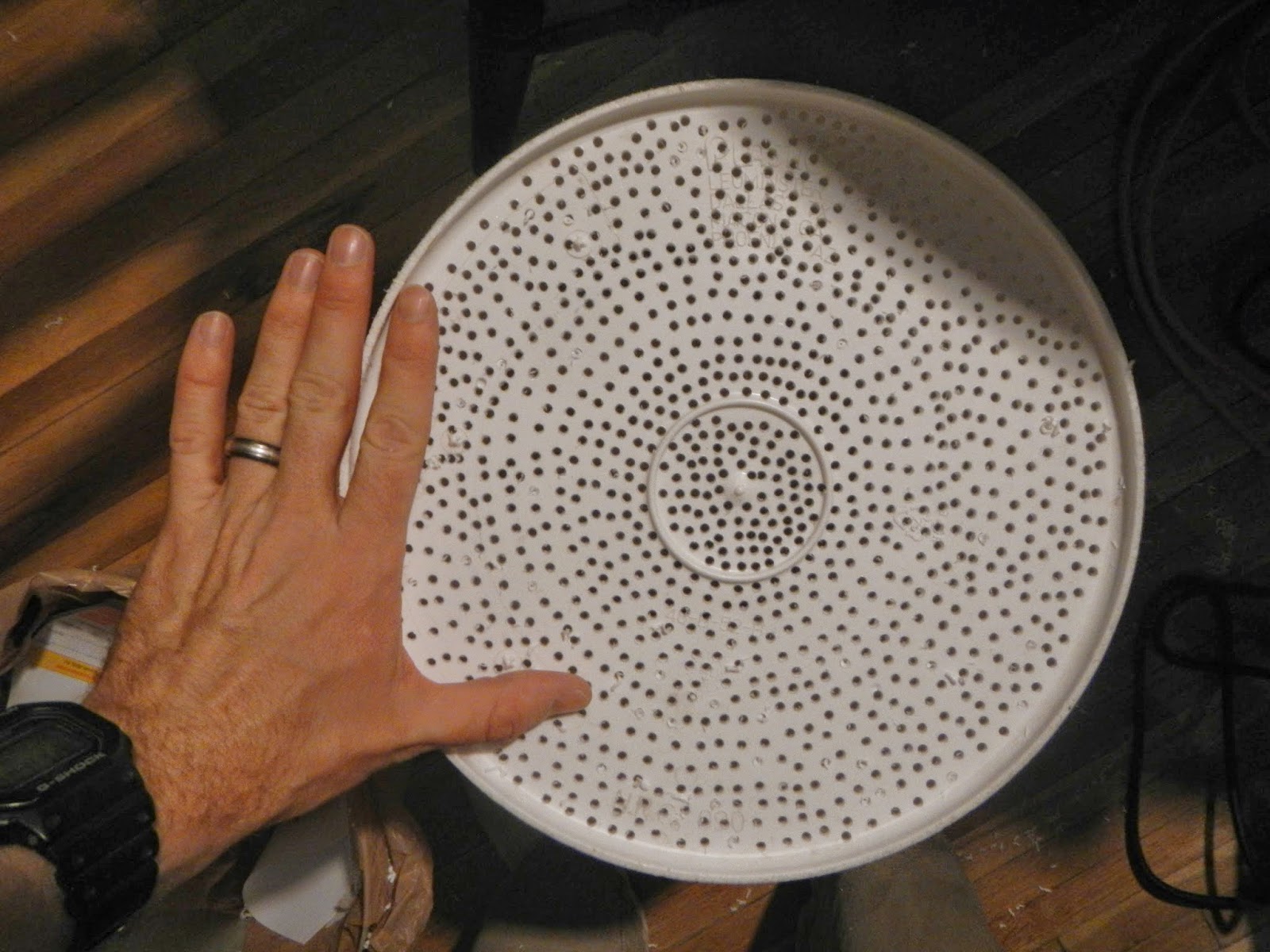
Charlie’s method drilling some holes in the bottom of one bucket and placing this into another bucket with a spigot. A quick internet search said that a 1/8 inch drill bit would do the trick. It took me about an hour to cover the bottom of the non-spigot bucket with holes.


Next Time

Overall though the process seemed to work. I got wort out of the grains and things seemed to be fermenting by the time I had to leave for two weeks. Of course, the proof will come in another two to three weeks. As expected, there were some learning points – especially since I decided to jump with a little less prep that I would have liked.

Stirring the Grains for the second batch sparge

I ended up using about 15 pounds of grain. If I were to do it again, I would probably start with a “smaller” beer. But I wanted an imperial red, damn it. The problem with using so much grain in this set-up was that it was hard to mix the water and grain with a plastic spoon. It was made for brewing but it still bent a lot especially as it warmed up in the grains and water. This was not a problem for the initial batch of the batch sparge – I put in a little grain and water, mixed it, and then put in more grains and water. But when I did my second batch of my sparge it was hard to mix the grains. I could either get a stronger spoon (wooden paddle) or take the grains out. The first method is not guaranteed to work and the second sounds messy. I think I will eventually just go to a cooler and pipes whenI have time.

Insulation

I also put a towel around the set-up to keep in some of the heat. The temperature at which the grains and water are at is important because the process relies on enzymes in the malt. These enzymes like a particular temperature range. I think this set-up lost a little more heat that I would have liked. I might need to find some better insulation for next time.


Boil-off

The two pot set-up worked pretty well – but I lost a lot more to boil-off than I would have liked. I may switch to a less vigorous boil next time – especially after reading this article about induction heating which made it seem like the vigor of the boil was not as important as I had initially been led to believe.
 
Double pots in the background
Dead-space

I completely forgot about the dead space in the bottom of the mash-tun vessel. With the two bucket set-up this was significant (probably a little over a gallon). I was rather sad when I when to get rid of my grains and found these precious sugars just hanging out instead of boiling away with their friends. Unfortunately, at this point it was a little late to add it so this beer will not be as “imperial: as I had hoped.


Oh well. I will relax, not worry and have a homebrew. It will still be beer.